
Echo Calculator for Gyms: How to Measure and Fix Reverberation
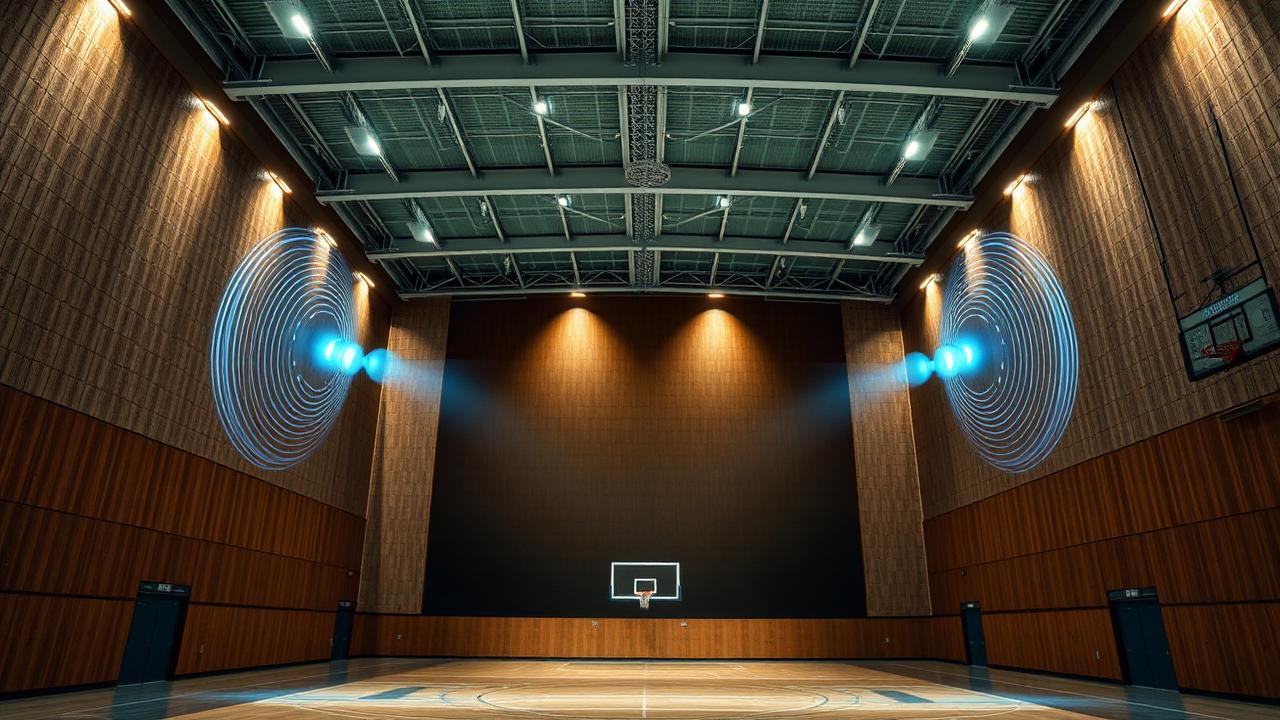
Use our echo calculator to estimate reverberation time (RT60) in your gym or sports facility. Learn the formula, ideal targets, and how to reduce echo with the right acoustic treatment.
If you've ever clapped your hands inside a gymnasium and heard the sound ring out for seconds, you've experienced excessive reverberation. That ringing isn't just annoying — it degrades speech intelligibility, increases noise fatigue, and makes every ball strike, whistle, and shout louder than it needs to be.
What Is Echo in a Gym?
Echo in a gym is caused by sound waves bouncing off hard, reflective surfaces — concrete block walls, steel roof decks, polished floors, and glass. In acoustic terms, this sustained reflection is measured as RT60: the time it takes for sound to decay by 60 decibels after the source stops.
Most untreated gymnasiums have an RT60 between 3.0 and 6.0 seconds. For comparison, a well-treated sports facility should target an RT60 of 1.2 to 1.8 seconds.
The Echo Calculator Formula
The Sabine equation is the standard method for estimating RT60:
RT60 = 0.161 × V / A
Where V is the room volume in cubic meters and A is the total absorption in sabins. Absorption is calculated by multiplying each surface area by its absorption coefficient (α).
Here's how to use it:
1. Measure your gym's length, width, and ceiling height 2. Calculate total volume (L × W × H) 3. List every surface material and its area 4. Look up the absorption coefficient for each material 5. Sum the total absorption (Σ of area × α) 6. Apply the Sabine formula
Typical Gym Surface Coefficients
Concrete block walls: α = 0.02–0.05 Steel roof deck: α = 0.05–0.10 Hardwood floor: α = 0.10–0.15 Glass windows: α = 0.03–0.05 SLN/CR NanoBaffle panels (NRC 0.70–1.15): α = 0.70–1.15
Why Your Gym Is Probably Over 3 Seconds
The math is simple. A typical 10,000 sq ft gym with 30-foot ceilings has roughly 300,000 cubic feet of volume but only 200–400 sabins of natural absorption. That produces an RT60 of 4+ seconds — far above the recommended range for sports use.
How Much Treatment Do You Need?
To bring a 4.0s RT60 down to 1.5s, you need to roughly triple the total absorption in the space. For most gyms, that means covering 15–25% of wall and ceiling surfaces with high-NRC acoustic panels.
The SLN/CR Acoustic Snapshot tool calculates this automatically for your specific room dimensions and surface materials. It generates a treatment recommendation in under 5 minutes — no acoustic consultant required.
Don't Guess — Calculate
Every gym is different. Ceiling height, wall materials, room shape, and even the number of courts all affect reverberation. A free Acoustic Snapshot gives you the data you need to make an informed decision.
Start your free Acoustic Snapshot at slncr.com/assessment
Ready to solve your noise challenge?
Get a Free Noise Assessment