
Metabarriers and the Future of Underwater Noise Control
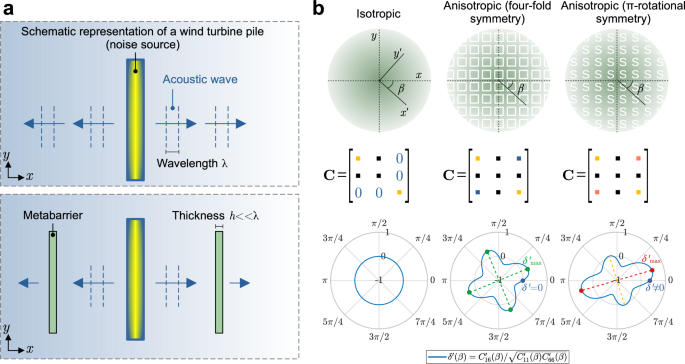
Researchers are harnessing normal-shear coupling in acoustic metabarriers to achieve deep sub-wavelength noise control underwater — a breakthrough with implications for marine environments.
Controlling low-frequency noise underwater has always been a stubborn problem. At frequencies where sound wavelengths stretch to meters or even tens of meters, conventional noise barriers become impractically large — you cannot build a wall thick enough to block sound that moves in such long waves. Acoustic metamaterials are changing that calculus, and new research published in npj Acoustics demonstrates a particularly promising approach: harnessing normal-shear coupling in metabarriers to achieve deep sub-wavelength underwater noise control.
Acoustic metamaterials are engineered structures designed to interact with sound in ways that natural materials cannot. By carefully designing the geometry and mechanical properties of a metamaterial's internal structure, researchers can create materials that exhibit unusual acoustic behaviors — negative effective mass density, near-zero compressibility, or, as in this case, strong coupling between normal and shear wave modes. This coupling is the key to the new metabarrier's performance.
When normal-incidence sound waves encounter the metabarrier, the coupling between compression (normal) and shear wave modes allows the barrier to interact with the wave in ways that conventional materials cannot. The result is effective noise attenuation at frequencies far below what the barrier's physical thickness would suggest is possible — hence the term "deep sub-wavelength." A metabarrier that might measure a few centimeters can attenuate sound at frequencies whose wavelengths span meters.
The practical implications for underwater noise control are substantial. Marine construction projects — pile driving for offshore wind foundations, dredging, underwater blasting — generate intense low-frequency noise that propagates vast distances and poses documented risks to marine mammals and fish. Current mitigation approaches, including bubble curtains and conventional acoustic barriers, provide meaningful but incomplete protection. Metabarrier technology could enable far more effective noise mitigation at these construction sites, reducing environmental impact while allowing projects to proceed.
The field of acoustic metamaterials is advancing rapidly, and applications are moving from laboratory demonstrations toward real-world deployment. This research represents a meaningful step in that trajectory — bringing deep sub-wavelength underwater noise control from theoretical possibility toward practical tool.
[Read the full piece](https://www.nature.com/articles/s44384-026-00056-7)
Ready to solve your noise challenge?
Get a Free Noise Assessment