
How Much Acoustic Treatment Do I Need? A Guide for Sports Facilities
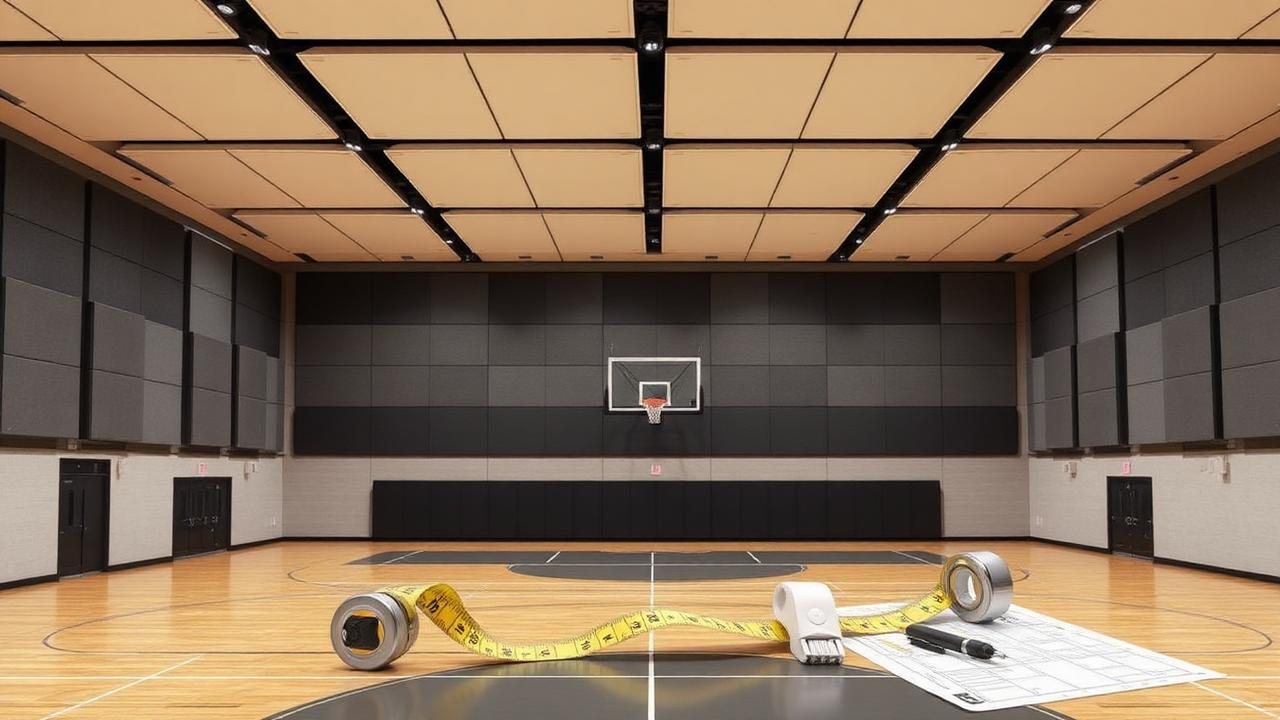
Calculate exactly how much acoustic treatment your sports facility needs. Coverage formulas, NRC ratings explained, and a free tool to get a personalized recommendation for your gym or court.
"How much do I need?" is the first question every facility manager asks when they realize their space has an acoustic problem. The answer depends on three things: how bad it is now, how good you want it to be, and what materials you choose.
The Quick Rule of Thumb
For most sports facilities, you need to treat 15–25% of the total wall and ceiling surface area with high-performance acoustic panels (NRC 0.85 or higher) to bring RT60 into the acceptable range of 1.2–1.8 seconds.
For severely reverberant spaces — converted warehouses, metal buildings, concrete gyms — plan for 25–35% coverage.
Understanding NRC Ratings
NRC (Noise Reduction Coefficient) measures how much sound a material absorbs on a scale of 0 to 1.0+. A material with NRC 1.0 absorbs virtually all sound that hits it. Most commodity "acoustic foam" has an NRC of 0.35–0.55. SLN/CR Core panels rate between NRC 0.70 and 1.15.
This matters because a higher NRC means you need less coverage. A panel with NRC 1.05 provides the same absorption as three panels with NRC 0.35. Less material, less cost, faster installation.
The Coverage Formula
Required treatment area = (Target absorption − Existing absorption) / Panel NRC
Where: - Target absorption = 0.161 × Room volume / Target RT60 - Existing absorption = Sum of (each surface area × its material absorption coefficient)
Step-by-Step Example
Facility: 8,000 sq ft, 24-ft ceilings, concrete block walls, steel deck ceiling
1. Room volume: 8,000 × 24 = 192,000 cu ft = 5,437 m³ 2. Current absorption estimate: ~320 sabins (hard surfaces everywhere) 3. Current RT60: 0.161 × 5,437 / 320 = 2.7 seconds 4. Target RT60: 1.5 seconds 5. Target absorption: 0.161 × 5,437 / 1.5 = 583 sabins 6. Additional absorption needed: 583 − 320 = 263 sabins 7. Using SLN/CR Core at NRC 1.05: 263 / 1.05 = 250 sq ft of panel
That's only 250 sq ft of treatment for an 8,000 sq ft facility — about 3% of floor area, or roughly 5% of available wall space. High-NRC panels make efficient work of even challenging spaces.
Where to Place Treatment
Placement matters as much as quantity:
- First priority: Upper walls (above 8 ft) where sound reflects most - Second priority: Ceiling baffles in open-truss or high-ceiling spaces - Third priority: End walls behind courts where ball impact noise concentrates - Avoid: Floor-level placement where panels are vulnerable to impact damage
Common Mistakes
1. Using low-NRC materials and compensating with massive coverage 2. Treating only one wall (creates uneven absorption and flutter echo) 3. Ignoring the ceiling (often the largest untreated reflective surface) 4. Using STC-rated products indoors (STC blocks sound transmission; NRC absorbs it — different problems)
Get Your Personalized Recommendation
Every facility is unique. The SLN/CR Acoustic Snapshot tool calculates your exact treatment requirements based on your room dimensions, surface materials, and performance targets. No guessing, no overcovering, no underspending.
Get your free treatment recommendation at slncr.com/assessment
Ready to solve your noise challenge?
Get a Free Noise Assessment